Thursday, April 30, 2020

China says it 'expelled' U.S. Navy vessel from South China Sea

Bloggers note : Bullies will be bullied

China says it 'expelled' U.S. Navy vessel from South China Sea

 
https://www.nbcnews.com/news/world/china-says-it-expelled-u-s-navy-vessel-south-china-n1196261
"The provocative actions of the United States seriously violated relevant international law norms," a spokesman for China's military said.
Image: The Arleigh-Burke class guided-missile destroyer USS Barry (DDG 52) conducting underway operations
The Arleigh-Burke class guided-missile destroyer USS Barry (DDG 52) conducting underway operations on Tuesday in the South China Sea.US Navy/Samuel Hardgrove / AFP - Getty Images
By Adela Suliman
China's military has said it "expelled" a U.S. navy vessel from the hotly contested waters of the South China Sea this week. It said the "USS Barry" had illegally entered China's Xisha territorial waters on Tuesday.
China's Southern Theater army command "organized sea and air forces to track, monitor, verify, and identify the U.S. ships throughout the journey, and warned and expelled them," said Chinese military spokesperson Li Huamin, in a statement.
"The provocative actions of the United States seriously violated relevant international law norms, seriously violated China's sovereignty and security interests, artificially increased regional security risks, and were prone to cause unexpected incidents," he said.
NBC News reached out to American officials who were not immediately available for comment overnight.
The South China Sea is a potentially energy-rich stretch of water and home to more than 200 specks of land. It serves as a gateway to global sea routes where approximately $3.4 trillion of trade passes annually.
The numerous overlapping sovereign claims to islands, reefs and rocks — many of which disappear under high tide — have turned the waters into a zone of competing diplomatic interests, embroiling neighbors. Beijing holds the lion's share of these features with approximately 27 outposts peppered throughout.
Tension has been simmering in the South China Sea, of late, particularly between China and its Asian seafaring neighbors Malaysia and the Philippines.
This month Vietnam also lodged an official protest with China, following the sinking of a Vietnamese fishing boat it said had been rammed by a Chinese maritime surveillance vessel near the Paracel Islands, in the South China Sea. China denied the claims and said the Vietnamese boat had illegally entered the area to fish and refused to leave.
Earlier this month, Secretary of State Mike Pompeo told his Southeast Asian counterparts that China was taking advantage of the world’s preoccupation with the coronavirus pandemic to push its territorial ambitions in the South China Sea.
"Beijing has moved to take advantage of the distraction, from China’s new unilateral announcement of administrative districts over disputed islands ... its sinking of a Vietnamese fishing vessel earlier this month, and its ‘research stations’ on Fiery Cross Reef and Subi Reef," Pompeo said in a video meeting with the foreign ministers of the 10-member Association of Southeast Asian Nations (ASEAN) on April 23.
Pompeo also accused China of deploying militarized ships to intimidate other claimant countries from developing offshore gas and oil projects in the region.
Last week, the U.S. Navy said it had partnered with the Australian navy for operations in the South China Sea, which began April 13.
"To bring this much combat capability together here in the South China Sea truly signals to our allies and partners in the region that we are deeply committed to a free and open Indo-Pacific," said Rear Adm. Fred Kacher, commander of the America Expeditionary Strike Group, in a statement.
The U.S. 7th Fleet is the U.S. Navy’s largest numbered fleet and routinely conducts operations in the Indo-Pacific area. It has said that all of its interactions during freedom of navigation movements have been in accordance with international norms.
The U.S. Navy has previously stated that sweeping maritime claims in the South China Sea posed a serious threat to freedom of the seas and the right of innocent passage of all ships.
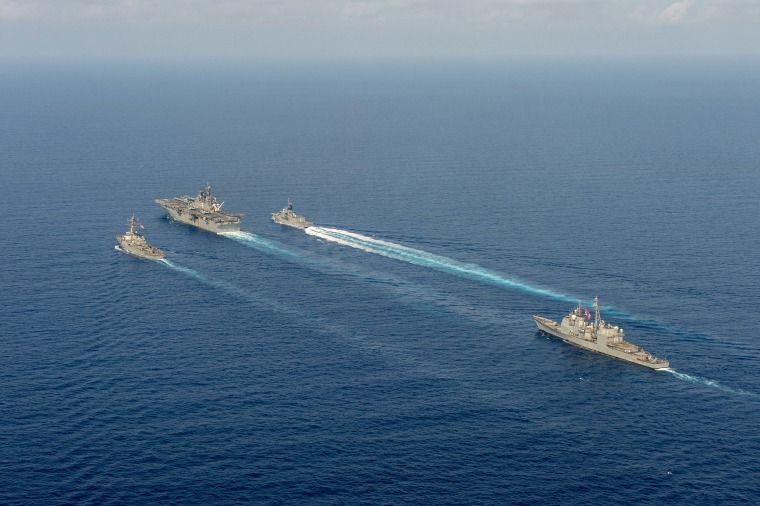
Image: RRoyal Australian Navy helicopter frigate HMAS Parramatta (top right) conducts officer of the watch manoeuvres with amphibious assault ship USS America, guided-missile destroyer USS Barry and guided-missile cruiser USS Bunker
Royal Australian Navy and U.S. Navy vessels conduct operations in the South China Sea.Australia Department Of Defence / Reuters
China has maintained that it has historical sovereign rights in the South China Sea, which neighboring countries have disputed. In this latest interaction, China said the U.S. was not acting "in line" with the wishes of other countries in the region, which want to "maintain peace and stability in that area."
Spokesperson Li also urged the U.S. to instead focus on its national COVID-19 crisis.
"We urge the United States to focus on the prevention and control of its national epidemic situation, do more useful things for international anti-epidemic efforts, and immediately stop military operations that are not conducive to regional security, peace and stability," he said.
The coronavirus pandemic has been a growing source of tension between the world's two largest economies, with both Washington D.C. and Beijing heaping criticism on each others' handling of the outbreak.
Li added that Chinese forces would continue to "resolutely perform their duties" in the South China Sea to "firmly maintain peace and stability."
The Associated Press contributed to this s

Saturday, March 21, 2020

COVID-19: les plans secrets du Pentagone et le Canada


COVID-19: les plans secrets du Pentagone et le Canada

Pour la première fois dans l'histoire moderne des États-Unis, le Pentagone vient de recevoir des ordres secrets de se préparer à assumer la «continuité du gouvernement», si la crise du coronavirus engendre des situations qui empêchent les autorités civiles d’exercer leurs responsabilités et d’assurer la sécurité intérieure.  
Selon Newsweek, le secrétaire à la Défense, Mark Esper, a signé, le 1er février, des directives secrètes ordonnant au US Northern Command (NORTHCOM) de «se préparer à se déployer» à l'appui de «missions extraordinaires potentielles» que pourrait provoquer la pandémie. Elles incluent «la possibilité d'une certaine forme de loi martiale», où des commandants militaires se verraient confier des pouvoirs exécutifs à travers les États-Unis.  
Ces plans d’urgence «Above-Top Secret» portant les noms de code OCTAGON, FREEJACK et ZODIAC sont désormais en place, rapporte Newsweek. 
En principe, le soutien que le NORTHCOM fournit aux autorités civiles est légalement limité par la loi du Posse Comitatus Act de 1878. Adoptée en réponse aux séquelles de la guerre de Sécession, elle restreint le rôle de l'armée américaine dans l'application des lois nationales. 
Mais la loi créant le Northern Command prévoit qu’en cas d'urgence nationale, naturelle ou d'origine humaine, il peut prendre en charge la situation. 
Vous ne le saviez sans doute pas, mais le Canada et le Québec sont dans le périmètre de sécurité américain relevant du Northern Command et l’armée américaine peut légalement intervenir au Québec pour des missions de sécurité intérieure. Remarquez, pas seulement au Canada, mais aussi au Mexique et partout ailleurs en Amérique du Nord.  
Le Northern Command a été créé à la suite de l’attentat du 11 septembre 2001 pour planifier, organiser et exécuter des missions de défense intérieure, de soutien aux autorités civiles et de «gestion des conséquences d’un événement terroriste utilisant une arme de destruction massive».  
Son aire de responsabilité englobe le Canada, le Mexique et le littoral nord-américain jusqu’à 500 milles nautiques des côtes des océans Atlantique et Pacifique, et comprend également le golfe du Mexique, le détroit de Floride, les Bahamas et une partie des Caraïbes. Contrairement au NORAD (North American Aerospace Defense Command), qui assure la défense aérospatiale du continent, l’état-major du NORTHCOM, dont le siège est au Colorado comme celui du NORAD, ne comprend aucun général canadien.  
Les responsabilités que Washington attribue au NORTHCOM empiètent sur la souveraineté du Canada, du Mexique et des Bahamas. Le Canada a-t-il été forcé de s’y intégrer? Ce qu’on sait, c’est que peu après la création du Northern Command, le gouvernement libéral de Jean Chrétien a signé, en décembre 2002, un «programme d’assistance civile» avec les États-Unis, qui prévoit les conditions de déploiement de troupes américaines au Canada à la suite d’une attaque terroriste ou d’une catastrophe naturelle. La pandémie de la COVID-19 actuelle correspond parfaitement à la définition d’une catastrophe naturelle. Elle est même de très grande envergure.   
L’état-major du Northern Command développe présentement des plans opérationnels d’intervention pour faire face à toute éventualité. Les scénarios catastrophes envisagés comprennent des violences causées par des pénuries alimentaires ou l’inaccessibilité aux soins de santé qui engendreraient des troubles dans les grandes villes américaines. Aux États-Unis, la dangerosité d’une telle situation serait amplifiée par la libre circulation des armes à feu, dont des fusils d’assaut. 
D’ailleurs, le Pentagone a ordonné à tout le personnel en uniforme de rester sur ou à proximité des bases militaires à travers les États-Unis afin d’être en état d’alerte et disposé à se déployer rapidement. L'armée américaine est elle-même vulnérable à la pandémie et cette directive de confinement sert aussi à protéger les militaires de la COVID-19.

Skateboarding In A Global Pandemic | COVID-19 Los Angeles